Year of the home-cooked apps

David Crawshaw co-founded Tailscale. And 6 years later, just as the company was taking off, he quit to build exe.dev. This level of conviction made exe.dev very interesting for me. But just going through the website, I didn’t really understand what the big deal was. Sure, a “cloud box” to run your agents, but how is it different from me setting up Tailscale on my server and SSH-ing into it?
I then saw the blogpost from fly.io where they were also going to bet the company on these vms for agents. This finally made me sign up for the $20/month plan on exe.dev. That, and some of my recent discussions, make me EXTREMELY excited about the future.
What is exe.dev?
This description from their website undersells them:
exe.dev is a subscription service that gives you virtual machines, with persistent disks, quickly and without fuss. These machines are immediately accessible over HTTPS, with sensible and secure defaults. You can share your web server as easily as you can share a Google Doc. With built-in optional authentication, so you can focus on your thing.
Your VMs share CPU/RAM—you pay for underlying resources, not per VM. Make a bunch!
For $20/month, you can launch many VMs that all share 2 CPU/8 GB RAM. That’s decent value for money, but also, it’s underwhelming as a pitch.
I need to carefully monitor LLMs on my machine because they can be prompt-injected to either exfiltrate or corrupt my data. This is especially a problem on the smaller/self-hosted LLMs. I wrote about it in Proxies, Sandboxes, and Agent Security.
Exe.dev has a clever take on this issue through their integrations, which let you run VMs with no secrets in them but still expose them to all the services they need. I can now let agents run wild and can even try vibe-coding from my phone! So I did just that, with the GitHub integration, and gave it access to an empty repo, and with the LLM integration, gave it access to an Anthropic key. And then kicked off a Claude code session with remote control that I can prompt from my phone.
And within an hour, I had an LLM-based linter for my writing based on the rules of Zinsser’s On Writing Well. I didn’t have to read a single line of code, and I could easily test and iterate by just visiting https://zinsserlint.exe.xyz. This process of building feels surreal! I still haven’t looked at the code, and I don’t think I will ever share this app, as it is also laundering Zinsser’s excellent work, but I am using it regularly.
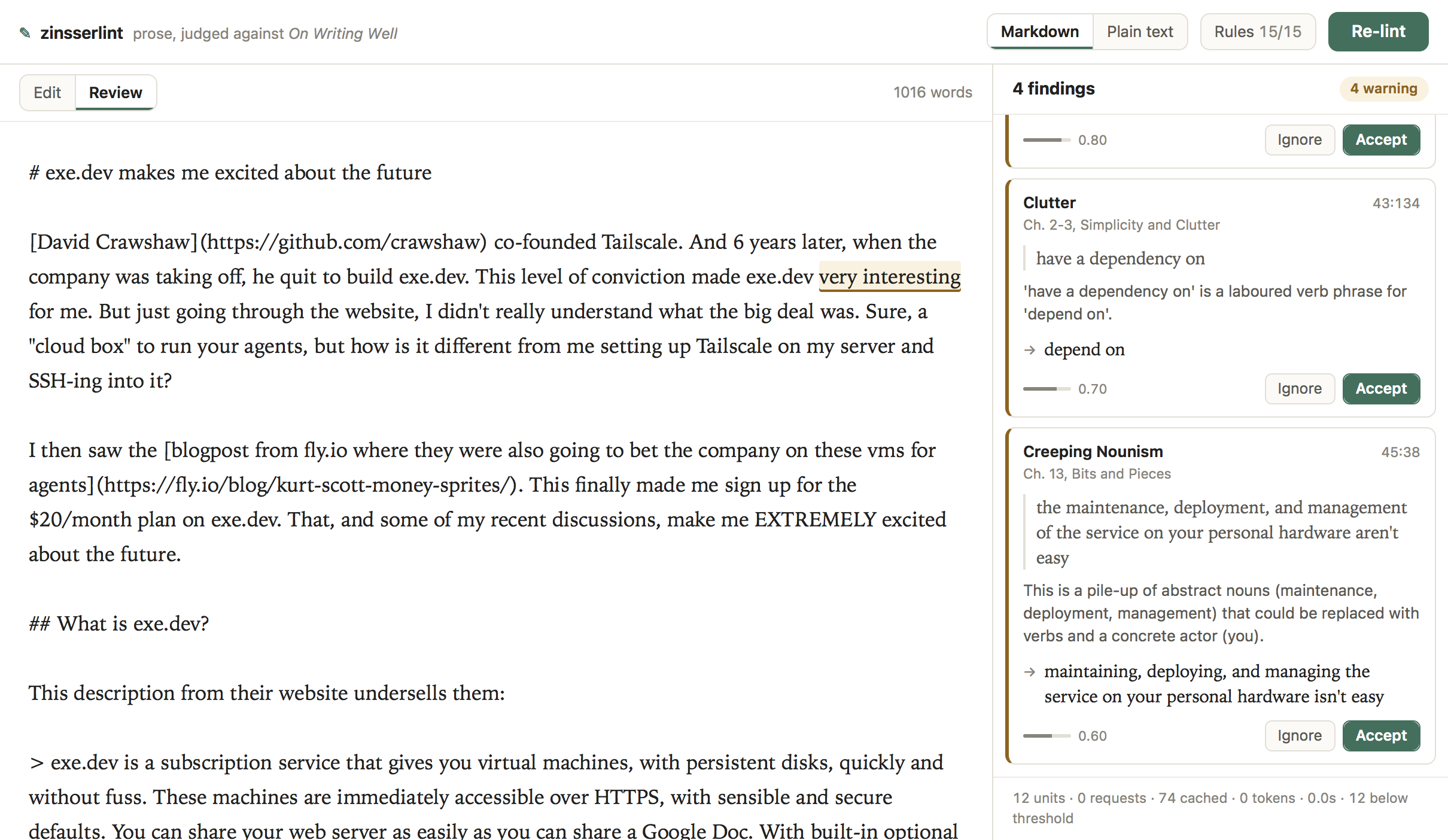
Rise of the home-cooked apps!
Yes, it’s slop. Yes, it is likely full of bugs and security issues. But I am not building a business on top of this or even exposing them to the internet. I am building these apps for myself. And I am loving every second of using them.
I became a software engineer because I wanted to build. But soon I found myself enjoying solving problems that come with scale and people. Building software used to take time, but I still built services and scripts to help myself. With AI, that overhead reduced dramatically. I am building and using more and more apps.
It still requires some expertise to do well. I was only able to build zinsserlint because I knew what to ask for, asking the agent to plan it first, and then iterating on the plan. But this barrier is going to go away. Many companies are working to solve this exact problem.
A friend in marketing, who had never written a line of code before, used Lovable to build a replacement for an expensive tool used for conference marketing. More and more people are figuring this out. A good signal for this is that communities on Reddit are banning vibe-coded apps because of the sheer volume. Everyone with an idea is now starting to build their dream app. Now these apps aren’t super secure or scalable and, as a result, are annoying people. But those complaints are moot if you’re only building for yourself.
Personal software should be lock-in free
Another barrier to everyone building the software for all their problems is cost. AI is expensive today, and it’s not easily accessible. Almost all the services in the space are VC funded and losing money, or in other words, subsidizing the service for us. It’s also forcing them to focus on the enterprise segment, because that’s where the money is. They are also focusing on locking in users and extracting value.
Lovable and the likes are especially good at this. I don’t blame them; figuring out how to do this right and pushing the frontier needs A LOT of money, and they need to justify their valuations. This does mean that personal software built on these platforms will never truly be personal.
OpenSource has a good track record of coming in and building viable alternatives to good ideas in closed-source software. In less than a year, we will see something like exe.dev in open-source, potentially even a compelling Lovable. Open-source AI is also catching up and forcing everyone to reduce their pricing. Maybe we will be able to have all of this for less than the cost of a single coffee.
Is it the year of the home-cooked app?
Not yet. We’ve made significant progress over the past year, but there is a long way to go. If you want to build an app that doesn’t depend on a proprietary platform, your best bet today is a CLI-based agentic harness like Pi, Claude Code, or Codex. And they aren’t accessible enough for non-software engineers.
And even if you do create a service, maintaining, deploying, and managing the service on your personal hardware isn't easy. But I think we will get there soon. To a world where everyone has a mini-computer running in their home that helps people build and use small, personal software reliably. All of this for less than $5/month.
Member discussion