Want to start up? Join one
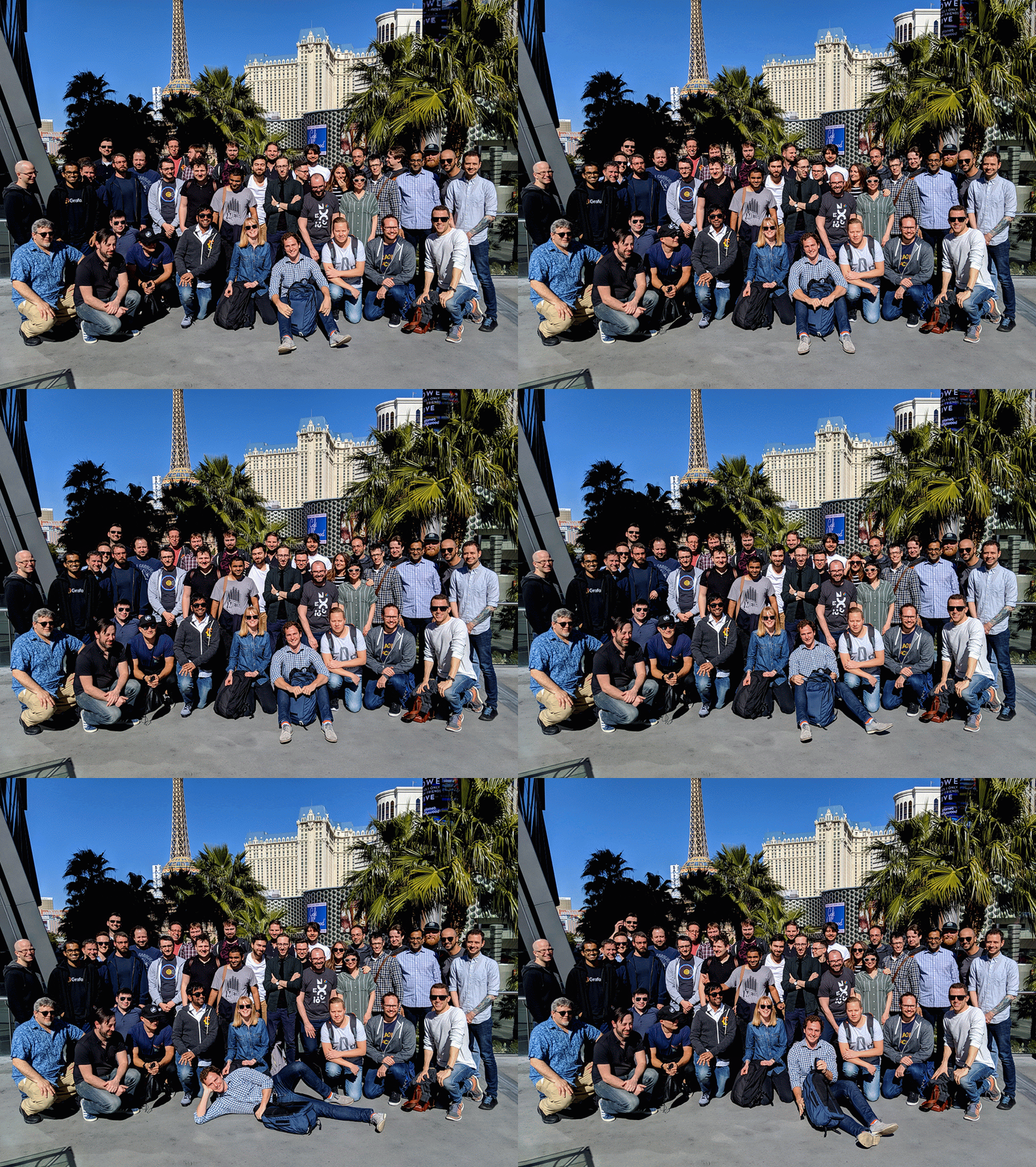
A friend reached out last week seeking advice. She had an offer from Google DeepMind and another one from a 10-person startup, and she was having trouble deciding between the two. I knew she wanted to start her own company and recommended the early startup, but given she goes above her traditional role. This was the third time I had to give this advice, and I think it's time for me to write this down.
My Story
I wrote a little about my journey here and here, but here's a quick recap.
I've always wanted to start a company of my own. When I was searching for my first job, I intended to only work there for 2 years, learn as much as I could, and then start up. I was open about this with everyone I spoke to.
I finally landed two offers, one from Grafana Labs and another that was offering ~twice as much money as Grafana. Grafana was smaller, and both Tom (my manager) and Raj (the CEO) were extremely supportive of my goals and actually consider it a massive success if ex-Grafana folks went on to start companies. In my mind, if the time range was only 2 years, the salary difference wouldn't really matter in the long-term.
I threw myself into work after I joined, and I tried to do anything and everything that was required. At first, I did write a lot of code, but after the launch of the first product, I aligned myself to making the users of the product successful. I overdid it to the extent that my primary goal was to help sales land deals and then make the customers successful with the products, and most of the code I wrote was in service of that.
But in hindsight, I am glad I did that. Every deal I helped land and every shoutout from customers got me noticed by the leadership and bought me a lot of social capital with them. I also have a special appreciation for sales now, and I know that a solid sales motion is critical for the success of any startup. I also have strong opinions on how to build products in the devtools space.
The keyword is initiative
Startup founders aren’t looking for people who need a lot of direction or oversight to be productive. They want people who are self-driven and can take initiative. This means never being idle. You must always keep your eyes open and look for opportunities to contribute and have impact.
Three things I did come to mind: Pre-sales, onboarding new engineers and customer support. In the beginning, we didn’t have a lot of sales folks and especially for the hosted-Prometheus product, Tom did a lot of the initial selling. I shadowed him and then eventually jumped on to any prospect call that Tom was too busy for. This was surprisingly effective as engineers prefer talking to other engineers over sales folks 😄
We didn’t actually grow much in my first 9 months. Our hosted Prometheus product wasn’t really performant for large customers and we (me, Tom and one other engineer) focused on making things work. As we started gaining traction, we grew the team and I focused a lot of my time on onboarding the new engineers into the team and codebase. Finally, as our customer base grew, so did the support load, and I shifted my focus to ensure the success of our customers.
Now, I might have overdone some of these functions, but the work that I did during these phases was important and got the attention of my leadership. I did some engineering in my second year at Grafana, but I also did a lot of ancillary work during that phase that fell completely outside my remit as a “software engineer”.
Of course, a lot of these things I did are not a replacement but on top of my regular work. You need to be prepared to work a lot at least in bursts. I understand that this advice is geared towards younger folks, but I think with seniority you should also be able to prioritise and delegate better to make space for the extra responsibilities.
Be open about your intentions
I told both Raj and Tom that I wanted to start my own company even before I joined Grafana and I told them I plan to leave in about 2 years. They were very happy to hear that. Raj told me he would love to see many startups from Grafana alums and that he would help me in my startup journey where possible. He had one condition though, I must give him a 6 month heads up. I can’t just drop a surprise on him and leave the next week. I thought it was fair given how small the company was.
The support I got from Raj, Tom and others was really good. Raj let me sit in our series A and series B pitches to investors and let me ask him all kinds of weird and thorny questions. Tom told me on day-1 that I needed to have an online presence and that I needed to closely interact with customers. He gave clear, pointed feedback after my early conference talks. Our early sales folks went the extra mile to include me in the process and I got to experience first hand how difficult and critical a good sales motion is. Now, we’re a much bigger company but I still get a lot of advice from Tom and can always reach out to Raj.
This is something that my friends struggle with. They are not always comfortable sharing their intentions as they feel that it might hinder their growth at the current startup. I think any good leader recognises that employees might leave at any point, and that it's their job to help people on their journey. And the only good way to retain people is to ensure that their needs are met. So if you share your intentions and it backfires on you, I think it's poor leadership and you're better off at a different startup.
I joined Grafana Labs to learn how to do a startup, but stayed for other reasons!
Align yourself to customers
One of the best things you can do is to align yourself to customers. Work with the sales team to help them sell, and with the support team to help them succeed. It will even help you become a better engineer. I wrote about it in depth here: Engineering should talk to sales (A story of Grafana Labs)
But one additional benefit is that it’s an easy and sure-shot way to get noticed by leadership and build credibility. Raj issued me extra stock options early on because, to quote him, "he was very impressed with my work around customers."
So yeah, jump on those customer calls, on to those support tickets and make it your life’s mission to ensure that customers are successful with the products.
Ask for 1:1s once you've built credibility
After about 6 months or so of stepping up and aligning yourself to customers, you will very likely have a good name in the eyes of your leadership. If possible, I’d schedule an occasional 1:1 with them. This 1:1 is not for them, this is for you. You need to go prepared with a set of questions and with a genuine intent to learn.
A small sample of questions:
- “what is not working with our sales motion?”,
- “what are your priorities for the next 3 months?”,
- “What is NOT working with our engineering culture?”,
- “Who is the competition that is catching your eye, and what’s special about them?”,
- “What made you look into a reorg (in reference to a recent reorg, restructure, etc.) and how did you approach it?”,
- “What is the board most concerned about?”
- “How do you bring in a new leader?”
I don’t expect every CEO, or CTO or VP to say yes to this request, but asking wouldn’t hurt. If they know your intention to startup, I think they’ll encourage it. And trust me, if done well, it will also help you become a more impactful employee.
Shape the culture
I treated Grafana Labs like my own company. Whenever I was unsure about something, I asked myself “is this behaviour / action something I want in my own company?” And every time the answer is no, I tried to change it or call it out. This requires a lot of confidence and honestly, I lost sight of this at times, but this is an important part of being an early engineer.
Further, when I was unsure if I should do something, I asked myself, “is this something I want to encourage in my employees?”, and if the answer was yes, I’d do it.
For example, I was unsure if I should be open about the fact that I am joining the product org (as a PM) for about 2 years to learn but then will likely move on to other things after. And then I realised in the company that I start, I want people who are curious to have the freedom to try things and that they should be open about it. God bless my manager who had no idea what to do with me as my 2 years were approaching :)
If at any point, you call something out and it backfires on you, and you can’t take it in stride, remember that you’re busting your ass for this company. And if you can’t be proud of it, it’s better to invest that time and energy elsewhere (maybe in your own company!!).
Member discussion