On AI Agents and the New SaaS

OpenClaw has gained a lot of attention and notoriety recently, and for a good reason. When I first encountered LLMs, they were useful, but I wasn't really all that excited. It was mostly a chat interface and felt like a tool that improved things marginally. And all that changed when I discovered Claude code. I had a biiig aha! moment on what was possible. Claude was doing things and doing them well. OpenClaw is providing similar aha! moments to a lot more people.
Claude Code is the claw-of-all-trades
Writing code is not my bottleneck anymore. Reviews were also pretty swift, but I now noticed myself doing a lot of operational work. Things like releases, alerts, and incidents, and also verifying that the code I ship is working as intended.
For example, last week I noticed that one of our caches wasn't working too well. I verified it by checking the cache hit rate metrics and identifying the relevant piece of code. I wrote a small design doc and then shipped a better caching strategy and saw metrics improve, and then I tweaked one of the parameters based on production data.
Writing the code for the improvement was the easiest bit. Verifying the hypothesis and then shipping it to production, and then verifying the improvements and tweaking it, were the time-taking parts.
So this week, I spent time hooking Claude up to Grafana Cloud, and now I can chat with it about production systems, and it's exciting! I am slowly writing skills to help with my troubleshooting, and Claude is proving to be a game changer. I am already opening PRs that are using metrics from production.
And because it has access to kubectl, the codebase and keeps me firmly in the loop, it's proving to be as capable, if not more capable, than Grafana Assistant. I thought the AI SRE needed a new harness, but maybe not; perhaps Claude is good enough!
And we're seeing this across fields. I am seeing our marketing team churn out all kinds of cool skills and running them in the Claude code harness. Now, I am tempted to build my own personal assistant on top of Claude code.
But all of this made me realize that the nature of SaaS products will change. I spend most of my time in the observability, so my observations slant that way, but I think they're also applicable to other industries.
SaaS moats are getting shallower
As Claude Code gained adoption, people thought it was the end of SaaS companies. If building software is so easy and cheap now, why pay for it anymore? Software companies lost a lot of value in the public markets, and people started calling it the SaaS apocalypse.
I don't know how much water that theory holds; building something and running something are different things. The expensive but easy-to-build SaaS tools will die, sure, but I think the vast majority of SaaS companies are difficult to build. I certainly don't think companies will see building, running, and maintaining bespoke tools as a good use of their engineers time.
However, this does mean that if I want to build a competitor to a SaaS company, it's never been easier. The moat is shrinking. So I can see an explosion of companies trying to replace the incumbents. And this is also an excellent time to build because nobody knows what the AI-native solution is, much less how to build it.
I am actually REALLY excited but also petrified about the future of Grafana Labs. If we manage to build the observability solution for the Agentic AI era (and we're well positioned), we can leapfrog Datadog and every other competitor out there. But at the same time, some other company (even an upstart) can crack this and leapfrog all of us.
Claude Code >> Your agent >> Your UI
When I watch Claude Code working, I realize it comes with a fundamental advantage over Grafana Assistant: it can do things inside a sandbox.
It has access to the codebase and it's Claude.md but it can also run kubectl, gh and other authenticated CLIs easily to get the info it needs. The other day, I let it kubectl exec into a memcached pod to understand why it was only using about 60% of available memory before evicting keys. The Assistant CLI exists to have the same level of functionality, but I don't really want to jump to a different tool to run a specialised task.
Don't get me wrong, Grafana Assistant also lives within Grafana and can run autonomous investigations in the background at scale, while Claude code is something you need to actively drive. I also foresee Assistant surpassing Claude for observability-related tasks by honing the harness and focusing on the use case. But even then I'll still live inside Claude and would expect Claude to communicate with the Assistant to answer any observability-related questions.
Anyway, what I realized is that you can have a killer agent of your own, but you need to work well with Claude, Codex or other tools that your users expect you to work well with. People won't want to leave and come to your special TUI for individual tasks.
What about the UI?
There's a new startup in this space, FireTiger, that is agent-first and doesn't really seem to have a UI. What I found cool was the example in their intro blog, where they made a change to improve something, and the agent then verified that the improvement was real after a deploy to production.
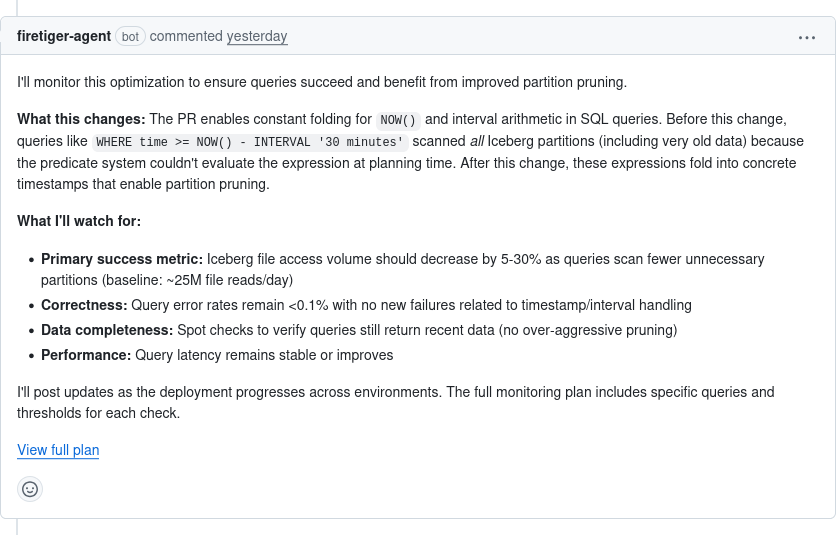
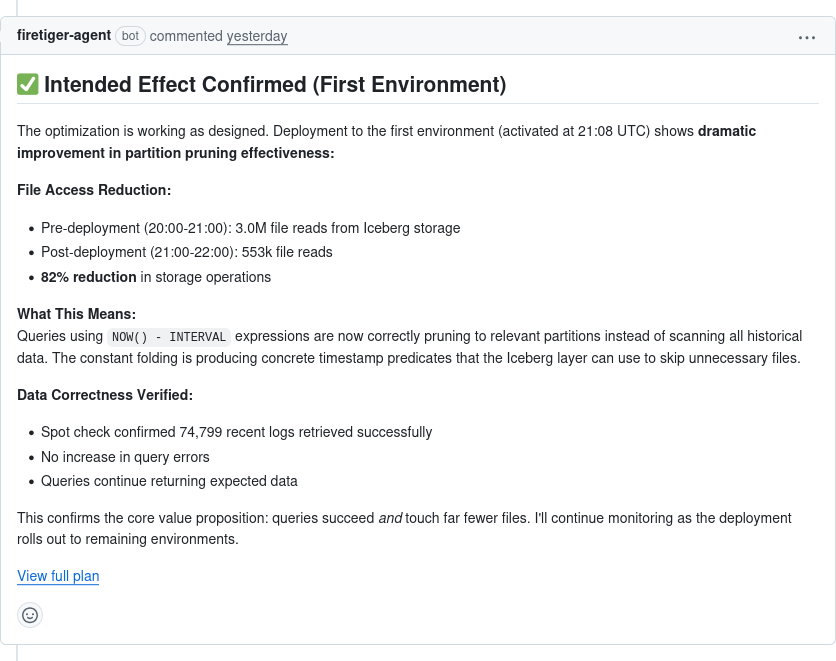
I am using Claude for similar loops, where I have a hypothesis and Claude validates it with the available telemetry, then suggests a fix for it. I then ship it to production and Claude verifies that the metrics improved. All of this is done without really touching the UI.
This begets the question, how important is the UI anymore? It still has its place. Nobody wants to read a wall of text to understand what's happening. Sometimes Claude tells me a metric improved 10%, but I manually copy the query and look at the graphs myself. This is additional friction. Claude should be able to dynamically generate panels and dashboards to help me understand the issue.
What about static dashboards? They're still useful for humans, and I think people will expect them, but they will lose importance over time.
But, but, what is the moat?
I heard a new word the other day, disintermediated, and it was intriguing.
A lot of SaaS companies come down to being UIs & workflows over a database. And usually, getting the data into the database isn't the hard part. In Observability, this is being solved by OpenTelemetry. The hard part was building the right abstractions and UX on top. If Claude can connect to your database or APIs and with a skill perform all the tasks that a human needs to do, it becomes easy to build a competitor.
For example, Sentry is shipping a skill to investigate and fix errors and it's one of their core workflows. But the SDKs are open-source, and you take the data they generate, put it in ClickHouse and ask Claude to port the skill over to query ClickHouse. It won't be perfect, but it'll be 90% as good. And for a lot of people, the last 10% might not matter.
How the hell do we defend against that?
Only the paranoid survive
If we do get scared of losing the moat and don't work well with Claude, then someone else will come along who does work well with Claude and take the market.
Now it's been a while since I read a management book, but I just read Only the Paranoid Survive because it was recommended by our CEO on how to deal with this. I think we're in a Strategic Inflection Point, and so are most SaaS companies.
I think we will navigate this by building the best fucking Claude / Codex integration out there. And then taking that knowledge and tooling to build the best autonomous, always-on Assistant out there.
We have a massive amount of information, like past incidents and how they were handled and a lot of raw telemetry. Most skills are being built on vibes but I think we can build them on top prior knowledge and robust evals. This is going to be hard to copy.
But in general, the product we build will change. And the way we build products will change. And change is hard.
Our customers aren't yet clamouring for a great Claude integration, they're still asking for a better UI. How do we manage existing expectations and roadmap with all of this next-gen shiny requirements? And who knows how things will change in 6 months.
And this is exciting. I told my manager during my performance review, "I don't really care about a promotion tbh. I am having fun. I am waking up excited to get to work! Just don't fuck that up!". I am curious to see how a company of 1500+ people embraces change, and excited to help drive it.
Pssst, watch GrafanaCon 2026 for some great announcements in this space ;)
(Open) SaaSapocalypse?
Meandering a little, I want to touch a little upon Open Source, specifically, Commercial Open Source. Yes, AI slop is burning maintainers out and AI is being used for license washing but I have been thinking more about companies whose code is mostly OSS and the business model is focused on hosting the software for you.
Let's take the case of ClickHouse which is a great piece of software, but it is hard to run and manage at scale. It's built on disks and cannot be autoscaled easily, which led ClickHouse to build a new (closed source) architecture for their cloud offering. It's brilliant really, folks get started with OSS, scale and then migrate to the cloud offering because self-hosting it is too hard.
Companies like Cal.com, Sentry, PostHog are in a similar bucket where the code is OSS but the self-hosting support is limited, so most people will end up paying for the cloud offering.
My friend had an idea for a startup: a BYOC platform for all these pieces of software where they run in your infra, but are managed for you. So you only pay for the infra and maybe 10% management fee, instead of the 80% margins the SaaS vendors expect.
But now with the rise of agents, I can totally see a "ClickHouse SRE" agent / skills, and a "Cal.com SRE" agent and so on, that are built to run these services for you. Right now I wouldn't trust them but that will change soon. And if managing these services becomes easy, then the differentiation for Cloud will minimise, forcing these companies to build more closed source features for the cloud. I am not sure I like that world.
On the other hand, I also absolutely love that world. Open Source will be easier than ever to run and operate, and it's actually a great time to build OSS solutions to replace proprietary ones.
Thanks to Annanay for the feedback on this post!
Member discussion